

In the professional floor cleaning industry, the terms floor scrubber and vacuum floor washer are often used to describe machines that wash floors, recover dirty water and clean surfaces in a single operation. However, especially in commercial and industrial cleaning, it is important to understand the actual functions of these machines, including scrubbing, dirty water recovery and, in some cases, the preliminary collection of dust and small debris.
Businesses looking for a professional vacuum floor washer usually need a solution capable of washing floors, vacuuming up dirt and leaving surfaces clean and dry in a single pass. However, choosing the right floor cleaning machine involves more than simply relying on the product name. Factors such as the working environment, the type of dirt, the cleaning frequency, the size of the area and the required productivity should all be carefully considered.
In this article, you’ll discover the differences between floor scrubbers and vacuum floor washers, how they work and which solution is best suited to your professional cleaning needs.
Table of contents
- Floor scrubber vs vacuum floor washer: what’s the difference?
- What are the advantages of a floor scrubber?
- What are the advantages of a vacuum floor washer?
- How to choose between a floor scrubber and a vacuum floor washer: key factors
- Floor scrubber or vacuum floor washer: choosing the right solution for your needs
- Frequently asked questions about floor scrubbers and vacuum floor washers
Floor scrubber vs vacuum floor washer: what’s the difference?
A floor scrubber is a professional floor cleaning machine designed to scrub, recover dirty water and dry floors in a single pass. Using a combination of clean water, detergent and rotating brushes, it effectively removes stubborn dirt, while the vacuum system immediately collects the dirty water, leaving floors clean, dry and ready for use. This streamlined cleaning process helps increase productivity, reduce cleaning time and improve overall operational efficiency.
A vacuum floor washer offers all the cleaning capabilities of a floor scrubber while adding the ability to collect dry debris such as dust, sand, granules, leaves and other small residues. Before or during the scrubbing process, a dedicated system collects dry debris, preventing it from being dragged by the brushes and improving the final cleaning result.
The terms floor scrubber and vacuum floor washer are often used interchangeably. However, the features and capabilities can vary from one model to another. For this reason, before making a purchase, it’s important to compare the machine’s technical specifications and functions rather than relying solely on the product name.
When choosing between a professional floor scrubber and a vacuum floor washer, the most important factor is not what the machine is called, but what it can actually do on the floor.
| Features | Floor scrubber | Vacuum floor washer |
| Functions | Scrubs + Dries | Vacuums + Scrubs + Dries |
| Type of dirt handled | Stubborn dirt, stains, oils, and grease | Mixed dirt, dust, small debris, and liquids |
| Applications | Industries, warehouses, retail stores, Ho.Re.Ca., healthcare facilities, cleaning companies | Offices, retail spaces, corridors, domestic environments, common areas, public spaces |
| Pre-cleaning required | May be necessary when debris is present | Often reduced or not required, depending on the model |
What are the advantages of a floor scrubber?
The advantages of using a professional floor scrubber include greater cleaning efficiency and better control of time and costs. Compared to traditional cleaning methods, these machines deliver more consistent results, reduce the need for manual labour, and improve workplace safety thanks to the immediate drying of surfaces.
The availability of different models with specific features and performance levels also makes it possible to identify the most suitable solution according to the type of flooring, the size of the area to be cleaned, and the level of dirt to be removed. For this reason, floor scrubbers are an effective cleaning solution for many professional environments, from commercial facilities to industrial sites, healthcare facilities, and public buildings. For further information, also read our article on how to choose a professional floor cleaning machine. Let’s now look at the main advantages of using a floor scrubber
Higher productivity on large surfaces

One of the main advantages of a floor scrubber is its ability to significantly increase cleaning productivity. The width of the cleaning path, the capacity of the tanks, and the efficiency of the vacuum system allow large areas to be cleaned in a shorter time.
Using a floor scrubber also helps standardise cleaning operations, ensuring consistent results even when frequent cleaning interventions are required. This aspect is particularly important in industrial and commercial environments, where continuous operations require floors to remain clean without disrupting daily activities.
Availability of walk-behind and ride-on models
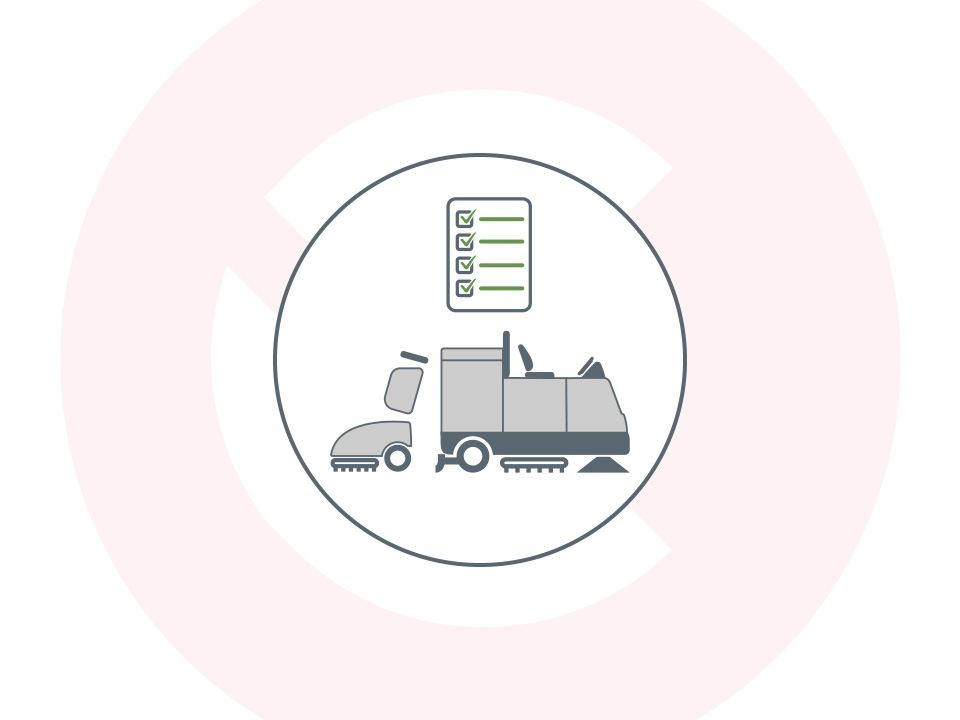
Professional floor scrubbers, unlike vacuum floor washers, are available in different configurations, from walk-behind models to ride-on versions, allowing them to meet the operational needs of many different environments.
Walk-behind floor scrubbers are compact, easy to manoeuvre, and ideal for medium-small areas or spaces characterised by narrow corridors, obstacles, and furniture. They offer an excellent balance between cleaning performance, operator control, and ease of use.
For very large surfaces, ride-on floor scrubbers are available, allowing operators to drive the machine comfortably while seated. This solution further increases productivity, reduces operator fatigue, and makes it possible to efficiently clean large areas such as industrial warehouses, logistics centres, airports, indoor parking facilities, and commercial buildings.
Ideal for stubborn dirt and intensive cleaning operations

Professional floor scrubbers are designed to tackle even the most stubborn dirt. The mechanical action of the brushes, combined with the controlled distribution of the cleaning solution, allows the removal of dust residues, oils, grease, footprints, and other substances that are difficult to eliminate with manual cleaning alone.
In industrial and production environments, where floors are exposed to heavy foot traffic and the movement of handling equipment, these machines allow deep and regular cleaning operations, helping maintain more consistent hygiene and safety standards.
Furthermore, the immediate recovery of dirty water reduces the risk of slippery floors and makes areas accessible again just moments after the machine has passed.
What are the advantages of a vacuum floor washer?
Vacuum floor washers, intended as machines that combine the collection of small debris, floor washing, and drying, also offer advantages in terms of speed and ease of use. They are particularly suitable for environments where floors may simultaneously have dust, small debris, liquids, and stubborn dirt throughout the day.
In these situations, the ability to reduce preliminary cleaning steps allows operators to intervene more quickly, especially in high-traffic areas, corridors, retail spaces, and small to medium-sized environments.
Let’s now look at the main advantages of using a vacuum floor washer.
Vacuums and washes in a single pass
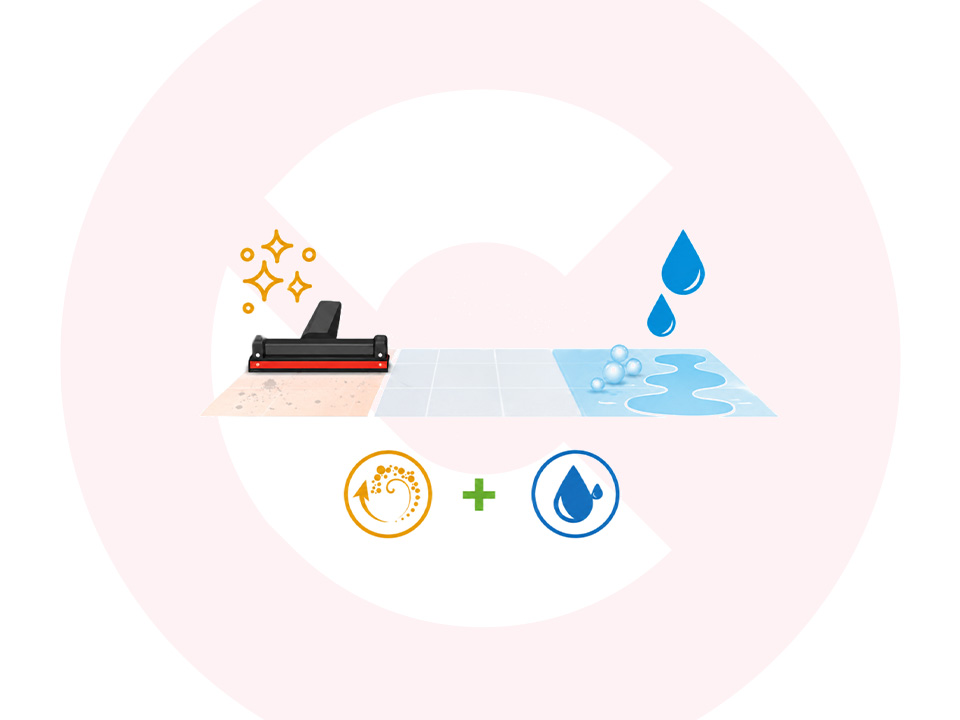
One of the main strengths of a vacuum floor washer is its ability to vacuum or collect small solid debris before or during floor cleaning operations. Unlike a floor scrubber, which requires the surface to be free of loose debris, a vacuum floor washer can simultaneously handle dust, small debris, liquids, and stubborn dirt.
This feature makes it possible to perform complete cleaning with a single operation, reducing working times and simplifying the operator’s tasks.
Eliminates preliminary sweeping operations
With a vacuum floor washer, the sweeping phase normally carried out before washing can be reduced or, in some cases, completely eliminated, because the machine is designed to collect coarse dirt and wash the surface during the same cleaning cycle.
In practice, operators can avoid a preliminary step with a broom or vacuum cleaner and intervene more quickly, especially in areas where dirt frequently builds up throughout the day. The possibility of performing multiple cleaning activities in a single operation represents a significant advantage in environments where frequent interventions are required without interrupting normal business activities.
Perfect for environments with mixed dirt

Vacuum floor washers achieve their best performance in environments where floors are subject to the simultaneous presence of solid residues, dust, liquids, and stubborn dirt, such as Ho.Re.Ca. and retail environments.
In these contexts, using a vacuum floor washer can significantly reduce the time required for cleaning operations while ensuring consistently high cleaning standards.
How to choose between a floor scrubber and a vacuum floor washer: key factors
The choice between a floor scrubber and a vacuum floor washer mainly depends on the characteristics of the environment to be cleaned and the specific operational requirements. Although both machines are designed to ensure high cleaning standards, each one provides optimal performance in different situations.
Carefully evaluating factors such as the size of the areas, the type of dirt present, and the layout of the spaces makes it possible to identify the most efficient solution, optimising working times, consumption, and operating costs.
Size of the environment
One of the first aspects to consider is the size of the surface to be cleaned.
For small and medium-sized environments, such as offices, shops, professional studios, and common areas, compact and easy-to-manoeuvre machines may be sufficient, as they can be easily used even in confined spaces.
When dealing with very large areas, such as industrial warehouses, logistics centres, and supermarkets, it is advisable to choose models with a wider cleaning path, larger tank capacity, and, when necessary, ride-on versions capable of delivering higher productivity.
Type of dirt
The nature of the dirt is another key factor when choosing the most suitable machine.
If surfaces mainly have fine dust, footprints, light production residues, or stubborn dirt without loose debris, a floor scrubber is generally the most suitable solution, providing deep cleaning and immediate drying.
If, on the other hand, floors are frequently affected by dust, solid residues, small debris, wood chips, leaves, or liquids, a vacuum floor washer allows operators to vacuum and wash in a single pass, eliminating the need for preliminary cleaning.
Frequency of use
The frequency of cleaning operations is another important aspect that should not be overlooked.
In environments where cleaning is carried out daily or several times a day, it is essential to choose robust, reliable machines designed for intensive use. In these cases, investing in a professional model, such as a high-performance floor scrubber, can result in greater operational efficiency and reduced maintenance costs over time.
If cleaning is performed less frequently, a vacuum floor washer can represent a valid alternative, as it simplifies cleaning operations while reducing the time required for each intervention.
Type of flooring
Every type of floor has specific characteristics that require different cleaning methods.
Smooth surfaces such as porcelain stoneware, resin, PVC, or industrial concrete can be effectively cleaned with both a floor scrubber and a vacuum floor washer, by selecting the most appropriate brushes and detergents.
For floors with deep grout lines, anti-slip surfaces, or particularly textured coatings, it is important to verify that the machine can provide adequate mechanical action and efficiently recover water and dirt, ensuring uniform cleaning results.
Floor scrubber or vacuum floor washer: choosing the right solution for your needs
There is no single solution that is better in every situation: the right choice depends on your operating environment.
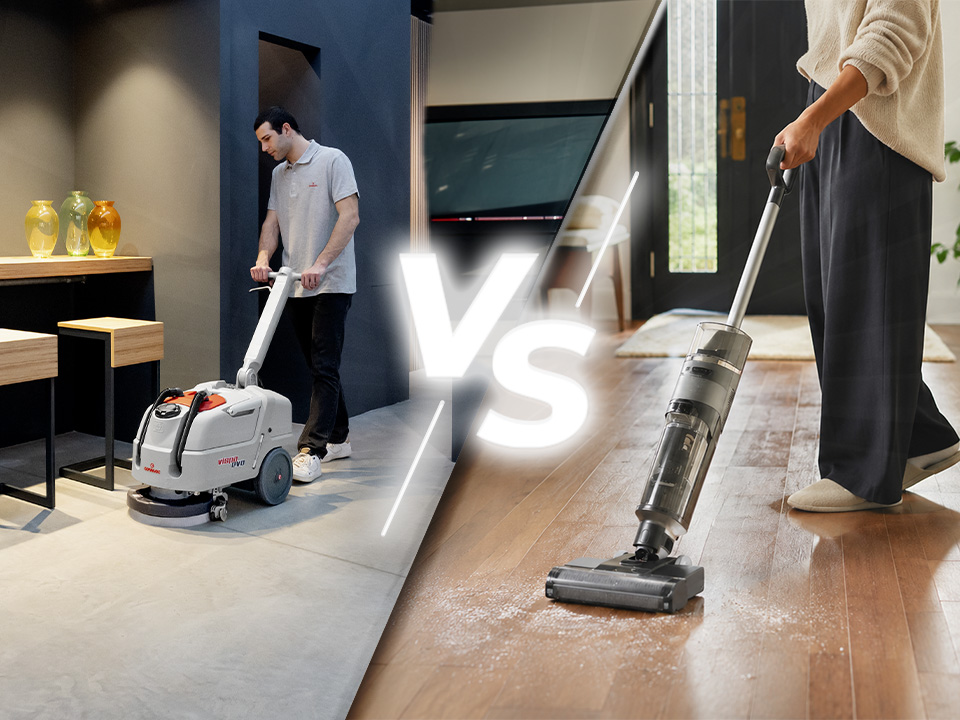
If your goal is to quickly scrub and dry floors that are already free of loose debris, a floor scrubber is the most efficient solution. On the other hand, if the floor is affected by mixed dirt, including small solid debris and liquids, a vacuum floor washer can perform multiple cleaning tasks in a single pass, increasing productivity while reducing cleaning time.
| Environment | Recommended machine | Why |
| Offices and common areas | Vacuum floor washer or compact floor scrubber | A compact, easy-to-manoeuvre machine is ideal for areas with obstacles where dust and small debris can accumulate. |
| Shops and retail stores | Vacuum floor washer or compact floor scrubber | The best choice depends on whether the floor has light mixed dirt or simply requires fast scrubbing and drying throughout the day. |
| Supermarkets | Walk-behind floor scrubber or ride-on floor scrubber | The right solution depends on the size of the area, aisle layout, cleaning frequency, and type of dirt. |
| Industrial warehouses | Ride-on floor scrubber | Delivers high productivity when cleaning large surfaces. |
| Logistics warehouses | Ride-on floor scrubber or combination cleaning machine | Recommended for large areas where debris generated by material handling is common. |
| Hospitals and healthcare facilities | Professional floor scrubber | Ensures rapid drying, operational continuity, and high hygiene standards. |
| Hotels | Vacuum floor washer or compact floor scrubber | Ideal for common areas, corridors, and spaces with frequent foot traffic or the presence of small debris. |
In conclusion, carefully assessing the characteristics of the environment and your cleaning requirements makes it possible to invest in the most suitable machine for your needs, achieving better cleaning results while optimizing operating costs over the long term.
Explore the complete range of Comac professional floor scrubbers and choose the machine that best suits your environment. Visit the dedicated Comac floor scrubber page or contact us for expert advice in selecting the right solution.
Frequently asked questions about floor scrubbers and vacuum floor washers
When should you choose a vacuum floor washer instead of a floor scrubber?
In everyday terminology, a vacuum floor washer refers to a machine capable of vacuuming or collecting dirt while washing the floor. It is worth considering when floors are frequently affected by mixed dirt, including dust, small debris, and liquids. Thanks to its vacuuming or debris collection function, it can reduce the need for preliminary manual sweeping, helping decrease both cleaning time and operating costs.
Can a floor scrubber replace manual floor cleaning?
Yes. A professional floor scrubber completely replaces traditional floor cleaning with a mop and bucket, delivering consistent cleaning results, reducing cleaning time, and leaving floors dry immediately after cleaning.
How often should a floor scrubber be maintained?
Routine maintenance should be carried out after every use by cleaning the tanks, brushes, squeegee, and all components that require regular care. Extraordinary maintenance, on the other hand, depends on the machine’s operating hours and the manufacturer’s recommendations.
Walk-behind or ride-on floor scrubber: which one should you choose?
The choice between a walk-behind floor scrubber and a ride-on floor scrubber mainly depends on the size of the area to be cleaned. Walk-behind models are recommended for small to medium-sized surfaces and offer excellent manoeuvrability in environments with narrow aisles or numerous obstacles. Ride-on floor scrubbers, on the other hand, are the ideal solution for cleaning large areas, as they increase productivity and reduce operator fatigue during cleaning operations.
This post is also available in:


