

Choosing the right professional sweeper starts with understanding the characteristics of the environment to be cleaned, the size of the surface and how the machine will be used. One of the first aspects to consider is the machine configuration: walk-behind sweeper or ride-on sweeper?
The two solutions are designed to meet different operational needs. Walk-behind sweepers focus on compactness, manoeuvrability and ease of movement in more complex environments. Ride-on sweepers, on the other hand, are primarily designed to increase operating continuity and productivity when cleaning larger surfaces.
There is therefore no single solution that is best in every situation. Comac sweepers are available in different configurations to meet the needs of commercial environments, warehouses, industrial facilities, car parks and large outdoor areas.
In this article, we analyse the differences between walk-behind and ride-on sweepers, comparing their features, productivity, hopper capacity, power supply and main applications. The aim is to provide a practical guide to identifying the industrial sweeper best suited to your cleaning requirements.
Table of contents
- Walk-behind and ride-on sweepers: what is the difference?
- How to choose between a walk-behind and ride-on sweeper: the main criteria
- Choosing the right machine: technical specifications for walk-behind and ride-on sweepers
- Battery, internal combustion engine or hybrid: which power supply should you choose?
- Frequently asked questions about walk-behind and ride-on sweepers
Walk-behind and ride-on sweepers: what is the difference?
The main difference between a ride-on sweeper and a walk-behind sweeper lies in how the machine is operated. With ride-on models, the operator drives the sweeper while seated on the machine. With walk-behind models, the operator walks behind the machine during cleaning operations. This different configuration affects the user experience, operator mobility and overall productivity.
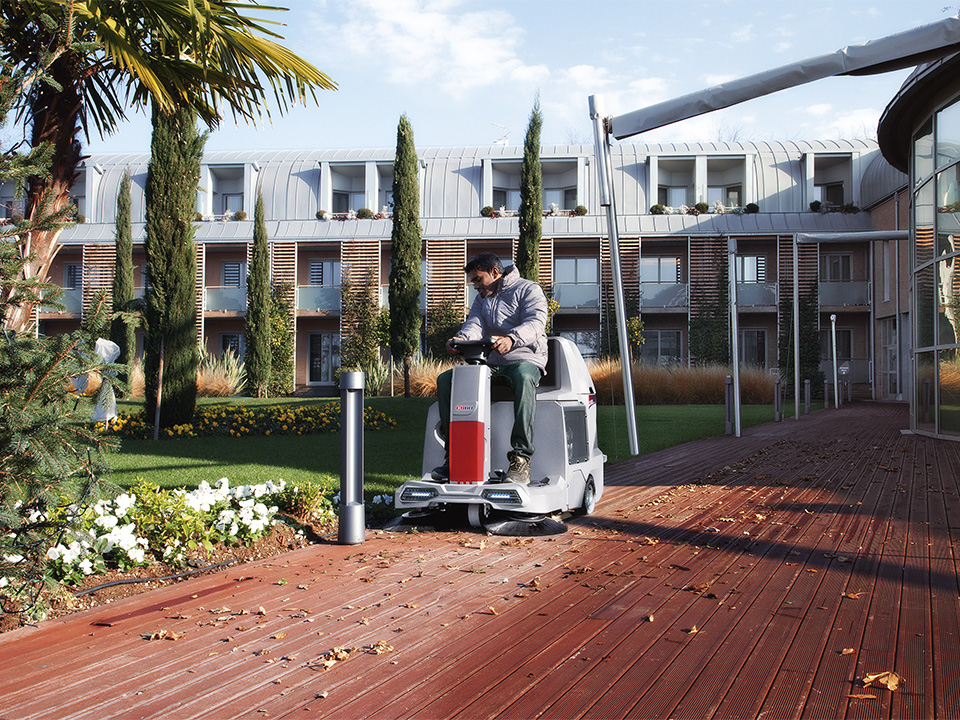
Ride-on sweepers are particularly suitable for medium-sized and large areas, where long distances need to be covered and continuous operation is required. The driving position allows the operator to minimise walking and manage extensive areas in less time.
Walk-behind sweepers, on the other hand, are generally more compact and agile. They are therefore suitable for environments with narrow aisles, shelving, obstacles or spaces where frequent manoeuvring is required.
In terms of operating principle, both configurations use brushes to collect and convey dust, sand and debris into the collection hopper. The choice between a walk-behind and ride-on sweeper therefore depends on the characteristics of the environment, the surface to be cleaned and how cleaning activities are organised.
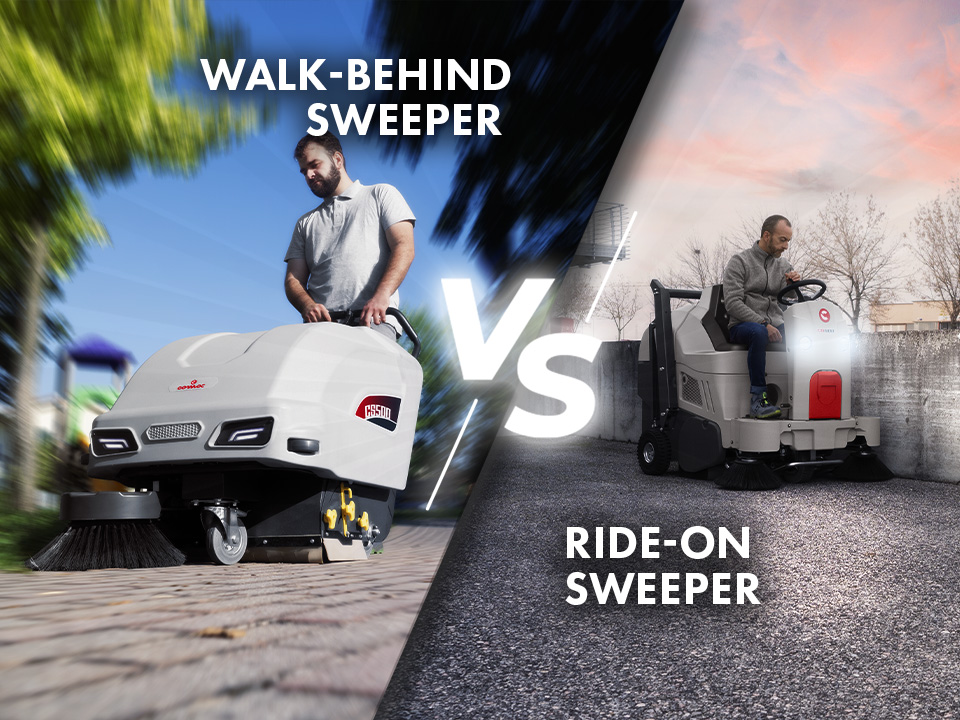
Functional comparison: walk-behind vs ride-on sweeper
To identify the most suitable configuration, it is useful to compare some of the main technical and operational parameters. Both walk-behind and ride-on sweepers are designed to collect dust, debris and residues quickly and effectively. However, dimensions, collection capacity, productivity and operating method can vary significantly.
The table below summarises the main differences between the two types.
| Feature | Walk-behind sweeper | Ride-on sweeper |
| Operation | Operator walks behind the machine | Operator sits on board the machine |
| Cleaning path width | 50–70 cm | 70–130 cm |
| Theoretical productivity (m²/h) | 2,000–3,000 | 5,000–11,000 |
| Waste hopper capacity | 30–60 litres | 65–570 litres |
| Ideal environments | Paths, aisles, car parks and smaller areas | Warehouses, car parks, logistics centres and large industrial areas |
| Operator fatigue | Medium | Low |
| Typical power supply | Battery / internal combustion engine | Battery / internal combustion engine / hybrid |
| Examples from the Comac range | CS50, CS500 | CS60, CS700/800, CS80/90/110, CS100/120 |
How to choose between a walk-behind and ride-on sweeper: the main criteria
How do you choose an industrial sweeper? The first step is to analyse the environment in which the machine will be used and how cleaning operations need to be carried out.
A walk-behind sweeper may be more effective in smaller environments with numerous obstacles or narrow passages. A ride-on sweeper becomes more suitable as the surface to be cleaned, the duration of cleaning operations and the need to maintain high productivity increase.
Before comparing individual models, it is therefore useful to consider:
- size and layout of the surface;
- width of aisles and transit areas;
- presence of obstacles and need for manoeuvring;
- frequency and duration of cleaning operations;
- quantity and type of dirt;
- how the machine will be transported;
- required power supply and operating time;
- availability of charging or refuelling infrastructure.
The aim is to find the right balance between productivity, autonomy, manoeuvrability, ease of use and operating costs. To learn more about how sweepers work, read the article: Sweepers: how they work and why you should choose one.
Surface size and operational layout: the impact of floor plans
The size of the surface to be cleaned is one of the first parameters to consider when choosing an industrial sweeper, but it is not the only one.
For small to medium-sized surfaces, a walk-behind sweeper can provide a high degree of flexibility. Its generally compact dimensions make it easier to move around environments with obstacles, shelving, narrow aisles and hard-to-reach areas.
In these situations, the floor plan can be just as important as the overall surface area. The width of aisles, doors and passageways must be compatible with the dimensions of the machine and the space required for manoeuvring. For example, a warehouse with narrow aisles may require a compact and particularly manoeuvrable machine, even if the total surface to be cleaned is significant. As cleaning surfaces become larger and operations require greater continuity, productivity becomes increasingly important when choosing a machine.
A ride-on sweeper allows the operator to cover longer distances without walking and is therefore particularly suitable for large warehouses, industrial facilities, logistics centres, car parks and outdoor areas. The surface should therefore be assessed as a whole, considering square metres, passage width and the presence of obstacles, which determine the machine’s actual efficiency.
Logistics and frequency of use: transport flexibility vs operating continuity
The frequency of use and the need to move the machine between different sites are also important factors when choosing a professional sweeper.
For a cleaning company operating across multiple sites, a walk-behind sweeper can be a particularly practical solution. Its more compact dimensions make transportation easier and allow it to be used in environments with different characteristics. This configuration is therefore interesting when operational flexibility is a priority: the same machine can be used in commercial environments, warehouses, production areas and other smaller spaces.
When the sweeper is used every day at a fixed site, especially for extended shifts and on large surfaces, productivity may become the main criterion. In these situations, a ride-on sweeper allows large areas to be covered with greater continuity, reducing the time required to complete cleaning operations and minimising the amount of walking required by the operator.
Type of debris and power supply: workload and environmental constraints
The type of dirt present in the environment is another factor to consider. Dust, sand, small debris, production residues and heavier dirt may require different features in terms of collection capacity, filtration system, autonomy and performance. The sweeper’s power supply should also be selected according to the environment in which the machine will be used.
Battery-powered sweepers produce no emissions during operation and are particularly suitable for indoor environments such as warehouses, industrial facilities, logistics centres and commercial premises. Depending on battery capacity and model specifications, they can provide sufficient autonomy for extended cleaning cycles. Sweepers with an internal combustion engine are particularly suitable for outdoor applications, where their high autonomy can be advantageous when cleaning large yards, car parks and industrial areas.
There are also hybrid sweepers, designed to combine different types of power supply and provide greater flexibility in environments with different operational requirements. The choice should therefore take into account not only autonomy, but also the operating environment, emissions, shift duration and the infrastructure available for charging or refuelling.
Application scenarios: the right sweeper for every industrial sector
Logistics warehouses, production facilities, car parks and cleaning companies have different requirements. For this reason, the choice between a walk-behind and ride-on sweeper should start with the actual conditions in which the machine will be used.
| Sector/environment | Main requirements | Recommended configuration |
| Warehouses and logistics | Large surfaces, aisles, dust and residues | Ride-on or walk-behind |
| Industrial facilities | Heavy dirt, large surfaces, frequent use | Ride-on |
| Commercial areas | Frequent cleaning, indoor spaces, attention to emissions and noise | Battery-powered walk-behind |
| Car parks and outdoor areas | Large surfaces, dust, sand and debris | Ride-on, including internal combustion engine models |
| Multi-site cleaning companies | Flexibility, transportation and use in different environments | Walk-behind |
| Small and medium-sized surfaces | Agility, manoeuvrability and ease of use | Walk-behind |
| Large industrial surfaces | High productivity and continuous operation | Ride-on |
To compare all the Comac solutions available, visit the Comac sweepers page.
Choosing the right machine: technical specifications for walk-behind and ride-on sweepers
Once you have identified the most suitable configuration between a walk-behind sweeper and a ride-on sweeper, it is important to compare the main technical specifications. Cleaning path width, collection hopper capacity, productivity, power supply, operating autonomy and filtration system are some of the parameters that can affect machine efficiency.
However, no single figure should be assessed in isolation. Choosing the right industrial sweeper means considering the relationship between technical features, surface size, layout, quantity and type of dirt, and the way the machine will be used.
Cleaning path width
The cleaning path width indicates the width of the surface that the sweeper can clean in a single pass and is directly related to the machine’s potential productivity.
Walk-behind sweepers generally feature more compact cleaning paths, making them suitable for aisles, narrow passageways and environments with obstacles.
Ride-on sweepers can offer wider working widths, which are particularly advantageous in industrial facilities, logistics warehouses, car parks and large outdoor areas.
However, a wider cleaning path does not automatically mean greater efficiency. In environments with numerous obstacles, a more compact machine may require fewer manoeuvres and deliver greater productivity in real-world use.
Waste hopper capacity
The hopper capacity determines how much dirt can be collected before the hopper needs to be emptied.
A larger hopper allows cleaning operations to continue for longer and reduces interruptions, particularly when large quantities of dust, sand and small debris are present.
In walk-behind sweepers, the hopper is generally more compact in order to keep the machine’s dimensions under control and facilitate manoeuvrability.
Ride-on sweepers can instead feature larger capacities, making them more suitable for extended operations on large surfaces.
This parameter should therefore be assessed in relation to the quantity of dirt and the duration of the cleaning shift.
Sweeper productivity
Productivity, generally expressed in m²/h, indicates the surface area that can theoretically be cleaned in one hour.
It is a useful figure for comparing models, but it does not necessarily correspond to actual productivity during operation. Actual productivity can be affected by:
- cleaning path width;
- travel speed;
- presence of obstacles;
- width of aisles and passageways;
- frequency of manoeuvres;
- quantity and type of dirt;
- need to empty the hopper during the shift.
In general, a ride-on sweeper allows greater operating continuity on larger surfaces, while a walk-behind sweeper may be more efficient in smaller or more complex environments, where manoeuvrability is a key factor.
For this reason, before comparing the m²/h values declared by manufacturers, it is essential to consider what the machine’s actual productivity will be in the environment where it is used.
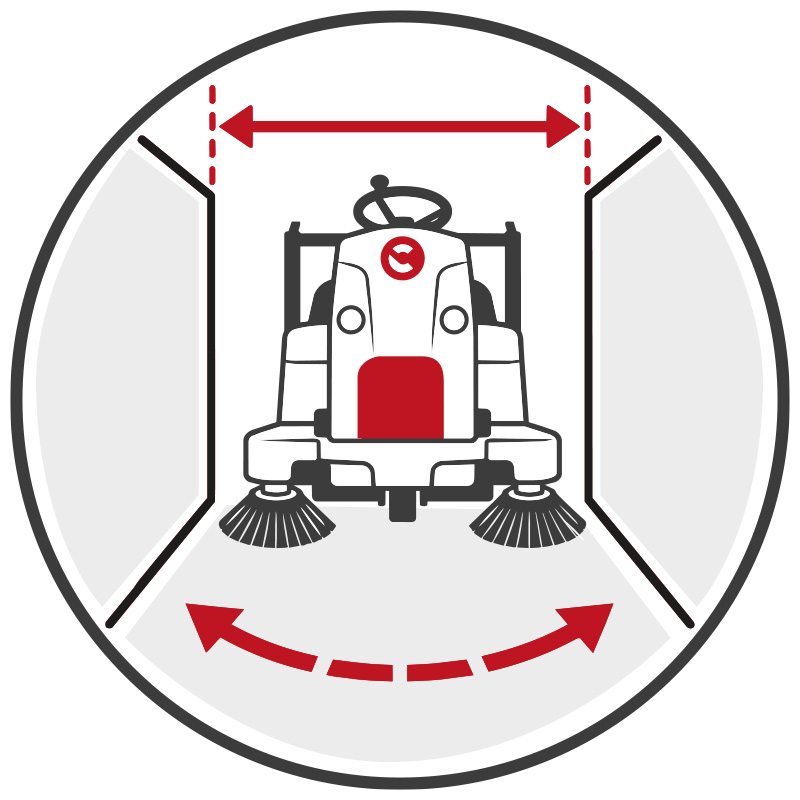
Minimum transit width and manoeuvrability
The minimum transit width is often underestimated, but it is essential for verifying whether a sweeper is compatible with the available spaces.
Before choosing a machine, it is advisable to measure doors, aisles, passageways, turning areas and the spaces between shelving or other elements within the environment.
Walk-behind sweepers can offer an advantage in narrow spaces thanks to their compact dimensions and greater agility. Ride-on machines, while generally providing higher productivity, require adequate space for travelling and manoeuvring.
A machine that appears highly productive on paper may therefore prove impractical if it cannot move easily within the environment.
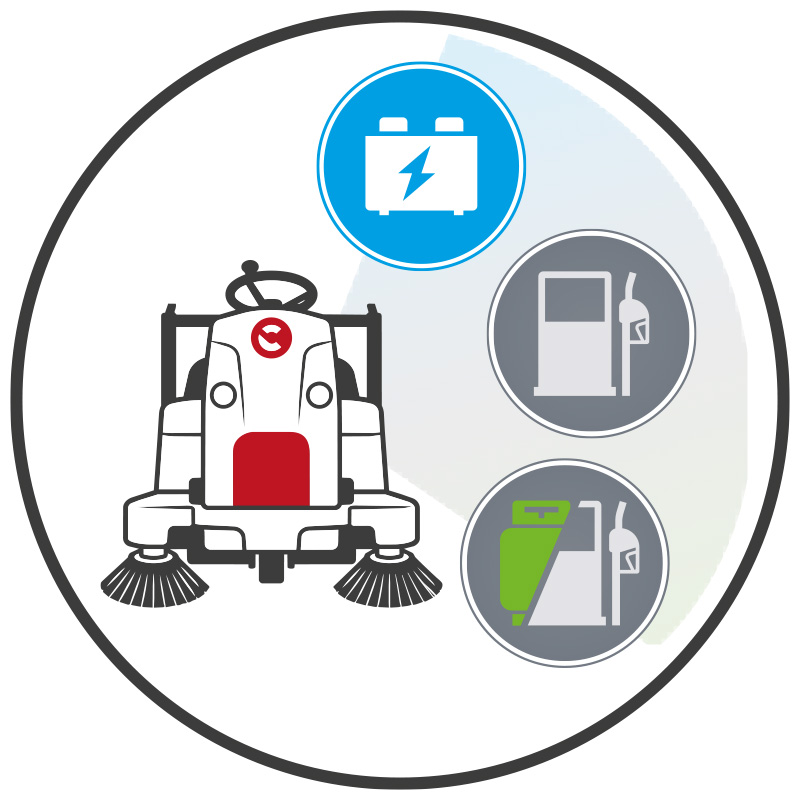
Power supply and operating autonomy
The type of power supply affects day-to-day operation and operating continuity.
Battery-powered sweepers are particularly suitable for indoor environments and applications where low emissions during operation and reduced noise are important. Battery autonomy should be assessed according to the duration of the shift and the possibility of recharging the machine.
Internal combustion engine versions are primarily designed for outdoor environments and extended cleaning operations.
Hybrid solutions can provide greater flexibility when the same sweeper needs to operate under different conditions.
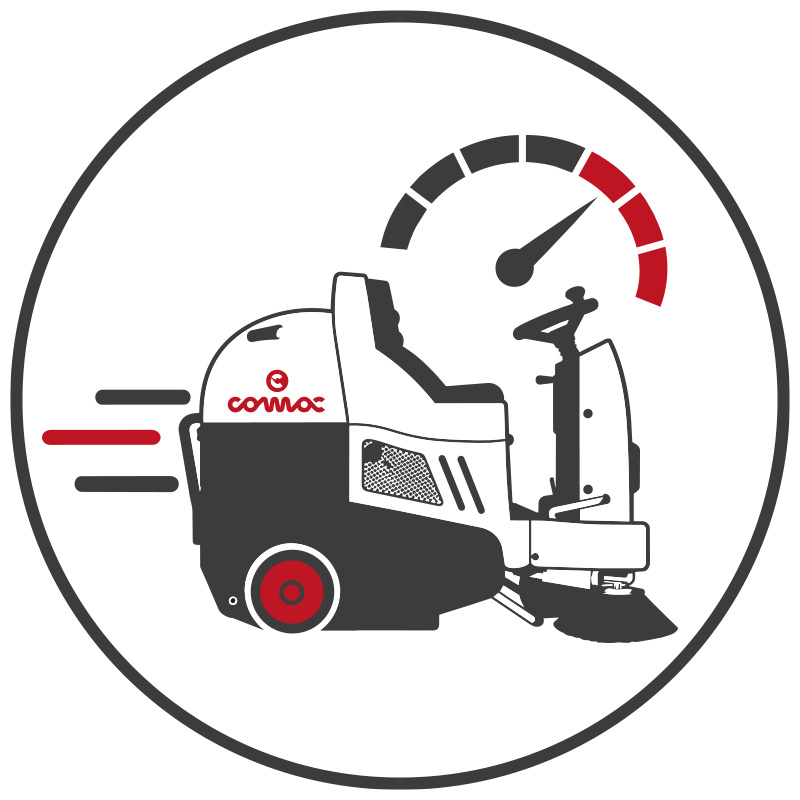
Travel speed
Travel speed is particularly important for ride-on sweepers because it contributes to the machine’s ability to cover large surfaces within a limited amount of time.
However, maximum speed does not necessarily correspond to the most effective working speed. During sweeping operations, the right balance must be found between travel speed, collection efficiency, amount of dirt and machine control.
For walk-behind sweepers, speed should instead be assessed mainly in relation to ease of operation and the operator’s ability to manoeuvre correctly in more complex spaces.
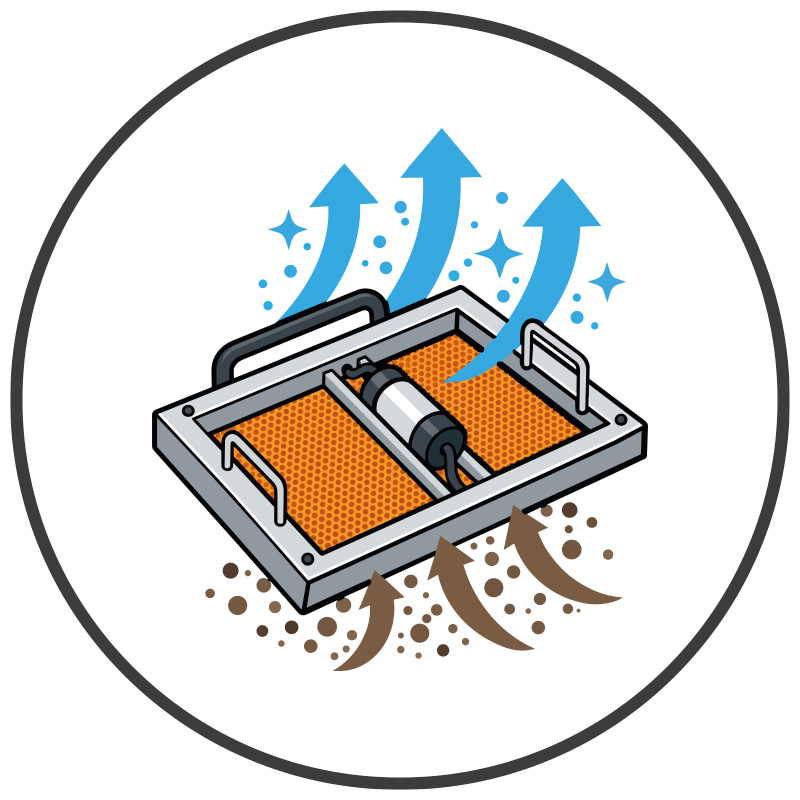
Filtration system
The filtration system helps retain dust generated during dirt collection and is particularly important in indoor environments.
Depending on the model and configuration, sweepers may be equipped with cartridge filters and dedicated filter-cleaning systems designed to help maintain efficient filtration during operation. For specific applications, HEPA filters may also be available, depending on the machine’s characteristics.
The filtration system should be selected according to the type of dust and dirt present in the environment, as well as any specific requirements of the site.
How to evaluate technical specifications before purchasing
Comparing technical specifications is therefore essential, but the most important factor is always how well they match the operating context.
A walk-behind sweeper can be the most effective choice when compactness, agility and ease of movement are priorities. A ride-on sweeper can offer significant advantages when the priority is to increase operating continuity and productivity on larger surfaces.
Before making a choice, it is therefore advisable to assess together:
- size and layout of the area;
- width of passageways and presence of obstacles;
- quantity and type of dirt;
- surface to be cleaned and frequency of operations;
- collection hopper capacity;
- theoretical productivity and actual productivity;
- power supply and operating autonomy;
- filtration system;
- maintenance times and requirements.
This makes it possible to identify not simply the machine with the highest specifications, but the professional sweeper best suited to the actual cleaning requirements.
Battery, internal combustion engine or hybrid: which power supply should you choose?
The choice of industrial sweeper power supply is closely related to the operating environment, the duration of cleaning shifts and the availability of charging or refuelling infrastructure.
Battery, internal combustion engine and hybrid technology have different characteristics and can be used both on walk-behind sweepers and on ride-on models.
Battery-powered sweepers
Battery-powered sweepers produce low emissions during operation and are particularly suitable for indoor environments. They are suitable, for example, for warehouses, industrial facilities, logistics centres, commercial premises and other areas occupied by personnel. Reduced noise and the absence of fuel during operation also make them suitable for environments where it is important to minimise the impact on the working environment. Battery power is a practical choice when the machine is used frequently and a fixed charging point is available.
Sweepers with an internal combustion engine
Sweepers with an internal combustion engine, powered by petrol, diesel or LPG depending on the model, are primarily designed for outdoor applications. One of their main advantages is their high operating autonomy and the ability to work without relying on the availability of an electrical power supply. This makes them suitable for industrial yards, car parks, logistics areas, large outdoor surfaces and environments where extended cleaning shifts are required. They are particularly interesting when charging points are limited or when operating conditions require long periods of continuous work.
Hybrid sweepers
Hybrid technology combines battery power and an internal combustion engine, providing greater flexibility when the machine needs to be used in different environments. When working indoors, the electric mode can be used, while the internal combustion engine can operate during outdoor activities. This approach allows the machine’s operation to be adapted to the characteristics of the area being cleaned. One example is the Comac CS60 Hybrid, a solution designed for environments where the machine needs to move between indoor and outdoor areas and manage different operational requirements with a single machine.
| Power supply | Main advantages | When to choose it |
| Battery | Low emissions during operation, reduced noise, no fuel required | Indoor environments, areas occupied by personnel, frequent use with a charging point |
| Internal combustion engine | High operating autonomy and independence from the electrical grid | Large outdoor surfaces, areas without charging infrastructure, extended shifts |
| Hybrid | Greater flexibility between electric operation and internal combustion engine | Mixed indoor/outdoor environments and facilities with different types of areas |
Ultimately, there is no single power supply that is best in every situation. The most effective solution is the one that meets the actual conditions of use.
For indoor environments, battery power offers important advantages in terms of emissions and noise; for large outdoor areas, an internal combustion engine can provide high autonomy and operating continuity; in mixed environments, a hybrid solution can offer the flexibility required to manage different activities with a single sweeper.
Frequently asked questions about walk-behind and ride-on sweepers
What is the difference between a ride-on sweeper and a walk-behind sweeper?
The main difference concerns how the machine is operated. With a ride-on sweeper, the operator drives the machine while seated on board, whereas with a walk-behind sweeper, the operator walks behind it. The two configurations meet different requirements in terms of productivity, manoeuvrability and surface area to be cleaned.
When should you choose a walk-behind sweeper?
A walk-behind sweeper is particularly suitable for small and medium-sized surfaces, environments with narrow passageways, obstacles and frequent changes of direction. It is also an interesting solution when the machine needs to be transported frequently between different sites.
When is a ride-on sweeper the right choice?
A ride-on sweeper is particularly suitable for large surfaces and extended cleaning shifts because it allows the operator to work on board the machine and cover extensive areas with greater continuity.
Is a battery-powered sweeper better than one with an internal combustion engine?
The choice depends on the operating environment. Battery-powered versions are particularly suitable for indoor environments, while machines with an internal combustion engine can be advantageous for large outdoor areas and extended cleaning shifts. Hybrid solutions offer greater flexibility in mixed environments.
What features should you consider before purchasing an industrial sweeper?
It is important to consider the size and layout of the environment, cleaning path width, collection hopper capacity, productivity, operating autonomy, power supply, filtration system, minimum transit width and frequency of use.
This post is also available in:


