

Automation is transforming the professional cleaning sector by introducing solutions such as the professional floor cleaning robot, designed to ensure operational continuity, consistent cleaning results and more efficient resource use, with minimal direct operator involvement.
But how do you choose the right robot for your specific operating environment? Which factors really influence performance and return on investment? And is the term “robot” always accurate, or are there more advanced, collaborative solutions designed to work safely in shared spaces with people?
This guide helps answer these questions and supports an informed choice of a professional floor cleaning robot, based on technical, strategic, and organizational considerations.
What are professional floor cleaning robots and how do they work
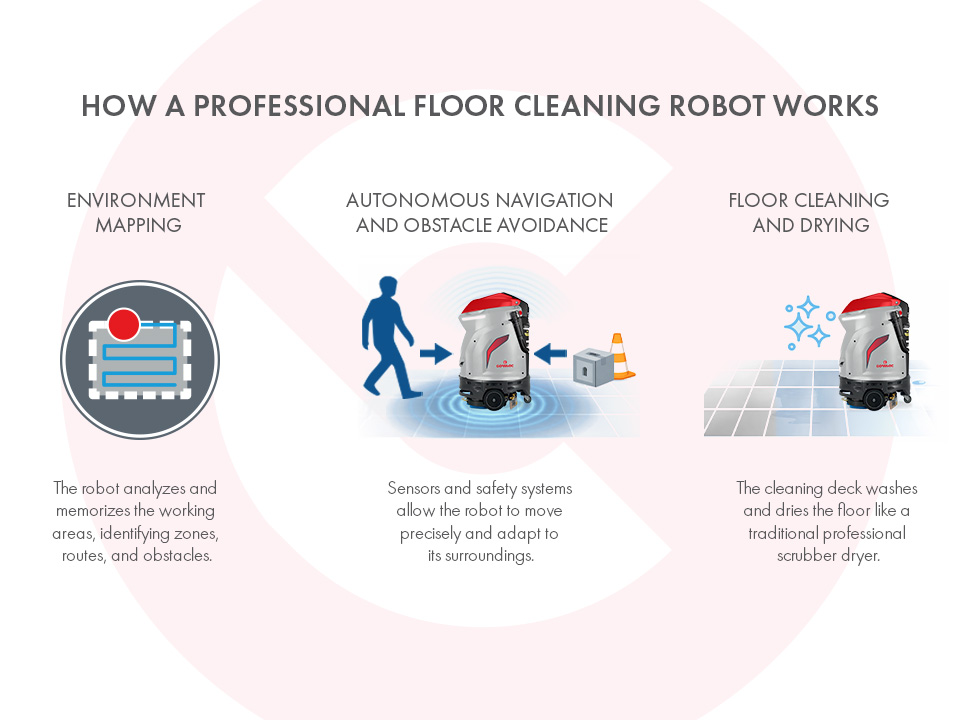
A professional floor cleaning robot is an autonomous machine designed to scrub and dry floors without constant operator control. Using navigation systems, safety sensors, and management software, it can operate in complex environments, detect obstacles and adjust its cleaning path.
In simple terms, a professional floor cleaning robot works through three main components:
- an initial mapping of the environment
- an autonomous navigation system with obstacle avoidance
- a cleaning deck comparable to that of a traditional professional floor scrubber
For a more in-depth explanation of what a floor cleaning robot is and how it works, you can read the article we published here on The Comac Blog.
Robot vs. Cobot: what are the differences?
In common usage, the term professional floor cleaning robot is often used broadly to describe automated cleaning solutions. From a technical perspective, however, it is useful to distinguish between robots and cobots in order to better understand how these machines operate in real-world environments.
A traditional robot is designed to work fully autonomously, often in restricted or controlled areas, with little or no interaction with people. A cobot, on the other hand, is designed to operate in shared spaces, working safely alongside people and adapting to dynamic environments.
This distinction is especially relevant in settings such as airports, hospitals, retail spaces, and industrial facilities, where a professional floor cleaning robot must move safely among people, vehicles, and changing obstacles without disrupting daily activities.
For this reason, in professional cleaning the term “robot” is commonly used to refer to autonomous floor cleaning solutions. In practice, most professional floor cleaning robots today follow a collaborative, cobot-like approach, while still being referred to as robots in market terminology.
In this article, we will therefore continue to use the term professional floor cleaning robot, as it is the most widely used, while referring to solutions designed to operate safely, collaboratively, and efficiently in real working environments.
Why switch to a robot? The strategic benefits for your business
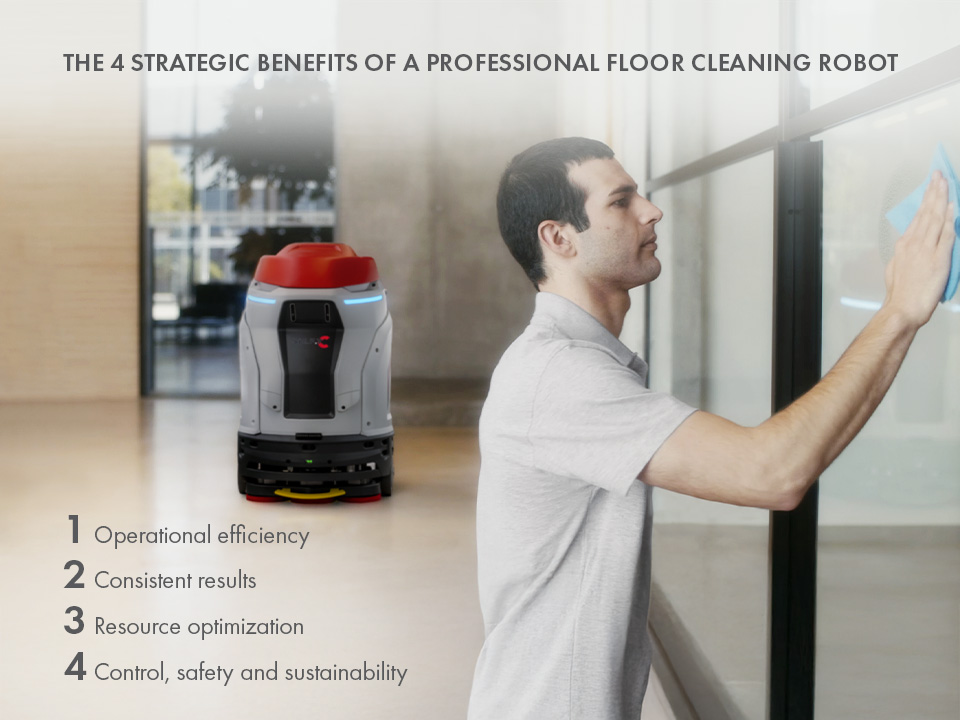
Choosing to use a professional floor cleaning robot is both a technological evolution and an organizational, strategic decision. When autonomous cleaning is correctly integrated, it helps improve daily operations, ensure greater operational continuity and increase control over cleaning processes.
For many businesses, the value of a professional floor cleaning robot goes beyond automating cleaning tasks. It also means measurable results, better cost efficiency over time, and more effective use of cleaning staff. Below are the main benefits of adopting a robot for professional cleaning.
24/7 efficiency and operating cost optimization
In certain operational contexts, robots make it possible to extend cleaning activities into partially unstaffed time slots, reducing downtime and optimizing machine utilization. This results in higher overall productivity while using the same available resources.
Consistent cleaning results and higher hygiene standards
Automation eliminates variability caused by human intervention. Each cleaning cycle follows predefined and repeatable parameters, ensuring consistent and traceable results, which is especially important in regulated environments.
Reallocating staff to higher-value activities
Introducing a professional floor cleaning robot does not replace people; instead, it frees up operational time. Staff can then focus on supervision, detailed cleaning tasks, or higher-value services.
Safety, data traceability, and sustainability
Professional floor cleaning robots are equipped with fleet management systems, such as Comac Fleet Care, which allow monitoring of consumption, routes, working time, and operational anomalies. This supports safety policies, helps measure sustainability goals, and reduces the waste of water, detergents and energy.
How to choose a professional floor cleaning robot: 4 key parameters to consider
Not all professional floor cleaning robots meet the same operational needs. Models that appear similar can offer very different levels of performance, autonomy and ease of management. For this reason, choosing a floor cleaning robot should not be based solely on technical specifications or price comparisons, but on practical criteria related to the areas to be cleaned, service continuity, and the company’s internal organization.
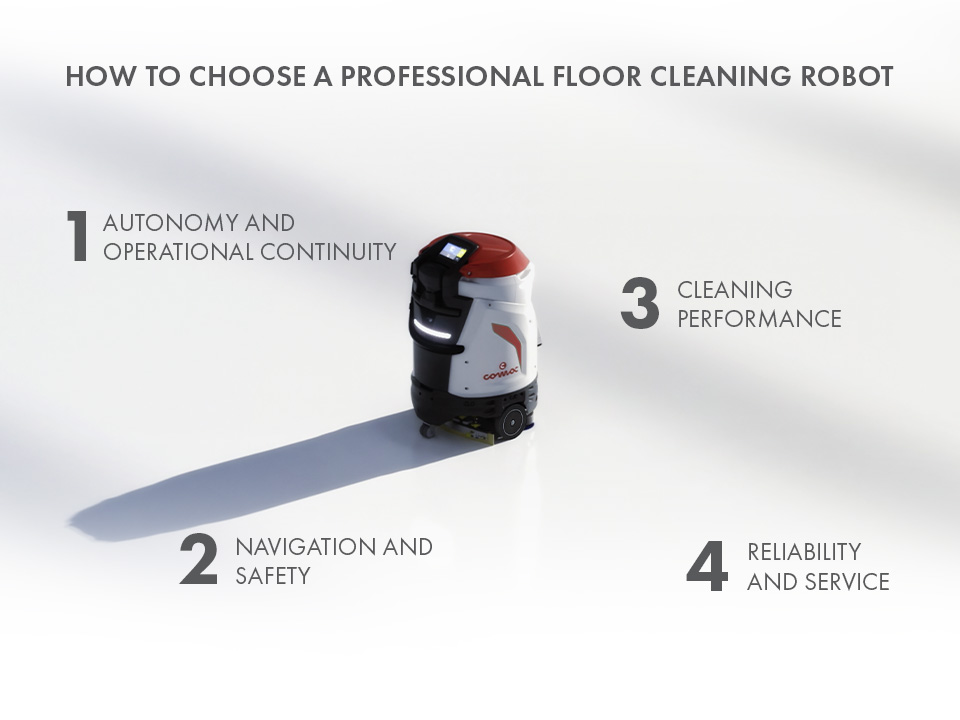
Below, we analyze four key parameters that help determine which professional floor cleaning robot is truly suitable for your operational requirements.
1. Autonomy, charging system, and downtime
The autonomy of a professional floor cleaning robot depends on battery capacity and the efficiency of the charging system. It is important to evaluate how much surface area the robot can clean on a single charge and how charging times affect the organization of cleaning activities. In large environments, adequate autonomy helps reduce interruptions and ensure greater operational continuity.
2. Navigation capabilities, sensors and obstacle management
A reliable navigation system must ensure precision, safety, and adaptability. Advanced sensors enable the robot to detect people, carts, pallets and changes in the environment without interrupting operations.
3. Cleaning performance: brush pressure, suction and tank capacity
Mobility alone is not enough. The cleaning performance of a professional floor cleaning robot must be evaluated using the same criteria as a traditional professional floor scrubber. This includes considering brush pressure on the floor, the effectiveness of the suction system and the capacity of both clean water and recovery tanks.
4. Manufacturer reliability and service support
A professional floor cleaning robot is a long-term investment. The manufacturer’s reliability, along with the availability of service, spare parts, and software updates, are essential factors to consider in order to ensure long-term operational continuity.
SELF.Y: Comac’s revolutionary cobot
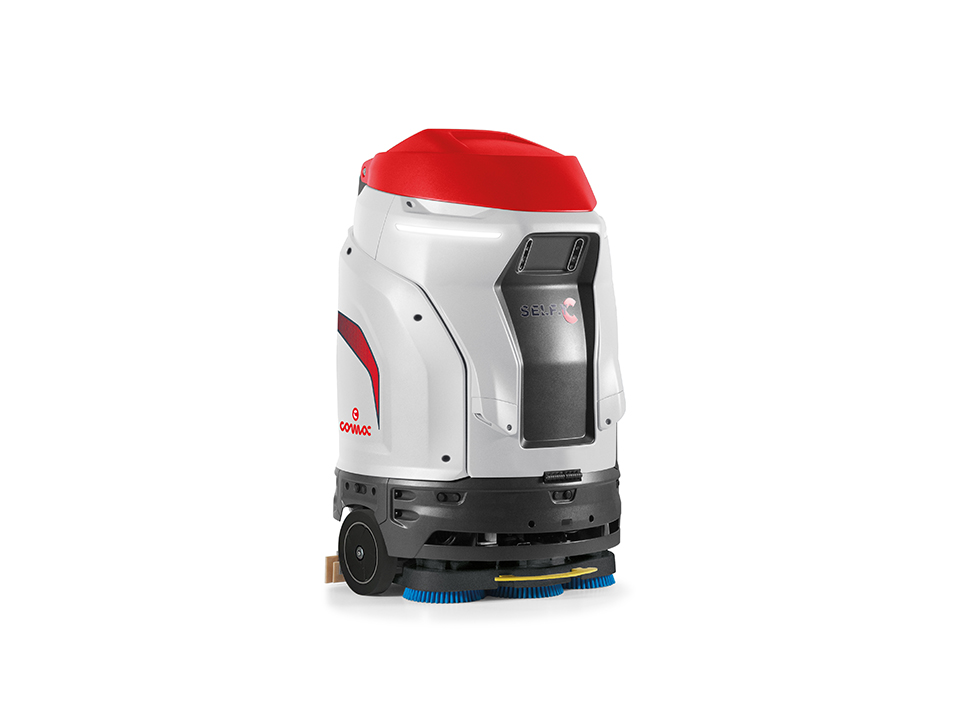
In the landscape of autonomous solutions, SELF.Y represents an advanced approach to the concept of the professional floor cleaning robot. It is a floor scrubber cobot designed to operate in reallo complex and shared environments, combining autonomy, safety, and high cleaning performance. SELF.Y is not designed to isolate the work area, but to integrate into daily operations, working alongside operators to support a more efficient and sustainable approach to professional cleaning.
Frequently asked questions
Routine maintenance is usually simple and scheduled, similar to that of a traditional floor scrubber. Tasks include cleaning the tanks, checking brushes and the squeegee, and inspecting sensors. In many cases, trained internal staff can manage routine maintenance.
A professional floor cleaning robot works on most common industrial and commercial floors, including porcelain tile, treated concrete, PVC, resin, and seamless surfaces. Suitability depends on the brush type, applied pressure, and machine configuration.
The ROI of a cleaning robot is calculated by considering reduced operating costs, improved productivity, consistent cleaning results, and extended operating hours. A complete analysis also includes indirect benefits such as safety, data traceability, and sustainability.
This post is also available in:


