Rent or buy? For anyone running a business, this decision is never just a financial matter. It represents a real strategic crossroads, one that affects operational efficiency, service continuity, and perceived quality.
When large areas need to be managed or high hygiene standards must be maintained, floor cleaning equipment rental is often seen as a quick and flexible solution. Fixed monthly fees, the absence of an upfront investment and the possibility of changing machines over time are commonly perceived as immediate advantages. But is it truly the best option for those seeking professional and consistent results over time? In this article, we look beyond the surface. We analyze when rental can turn into a recurring cost with no long-term value, and why, in many cases, purchasing cleaning equipment represents the real strategic investment for professionals.
Table of Contents
- What industrial cleaning machines are and when they are needed
- How cleaning equipment rental works
- The main cleaning equipment rental options
- Cost analysis: rental fees vs purchase depreciation
- Limitations of rental and advantages of purchasing
- When does cleaning equipment rental make sense?
- How to choose the right Comac solution for your needs
- Frequently asked questions
What industrial cleaning machines are and when they are needed
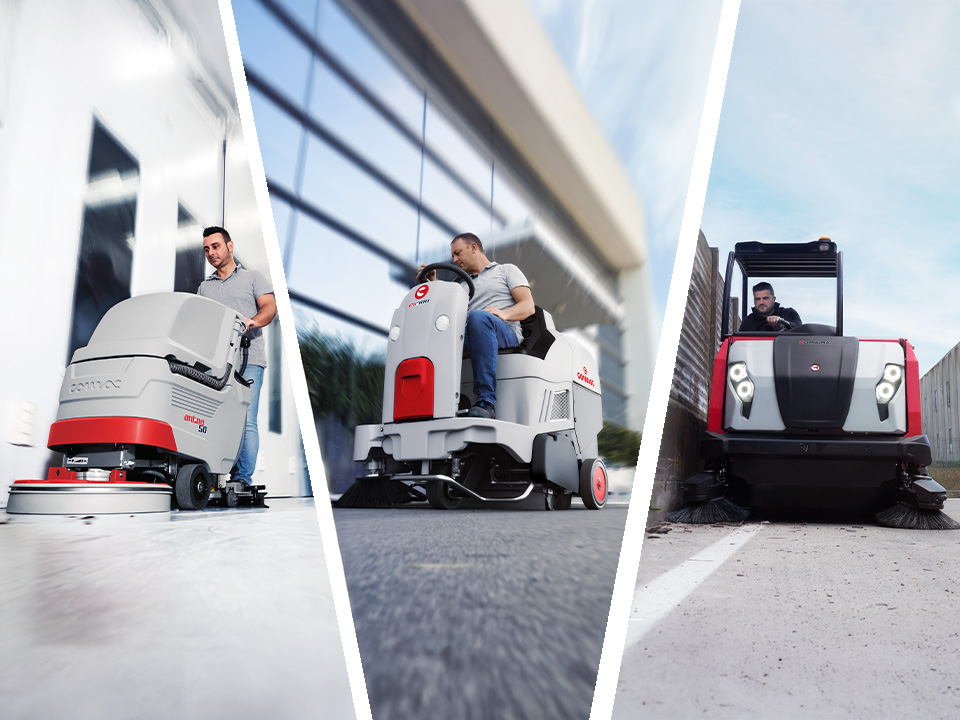
Industrial cleaning machines are designed to ensure professional hygiene standards on medium to large surfaces, reducing time and operating costs compared to manual cleaning.
The main categories of industrial machines that enable mechanized cleaning include:
- Walk-behind and ride-on floor scrubbers
- Sweepers
- Combination machines for sweeping and scrubbing
A company typically needs industrial cleaning equipment when:
- the surface area exceeds several hundred square meters;
- cleaning activities are regular or carried out daily;
- higher standards of hygiene and safety must be guaranteed;
- operating costs need to be controlled and labor hours reduced.
In these contexts, the machine is not an accessory but a critical element of the operational process. Service continuity and equipment availability therefore become key factors.
How does cleaning equipment rental work?
When evaluating available options, floor cleaning equipment rental often emerges as a flexible solution, mainly because it reduces the initial cost associated with purchasing a machine. At first glance, it appears to be an attractive opportunity to access professional equipment without taking on the responsibilities of ownership.
However, a more in-depth analysis reveals a different reality, especially for companies aiming to maintain consistently high hygiene standards. When cleaning needs are not occasional but a fixed part of daily operations, rental shifts from an apparent solution to a recurring operating cost, a fee that generates no long-term value.
Relying on an external service often means adapting to the machine that is available, rather than using the model best suited to specific surfaces or types of dirt. This compromise can lead to lower efficiency, longer working times, and suboptimal results, significantly reducing the perceived initial advantage.
Cleaning equipment rental options
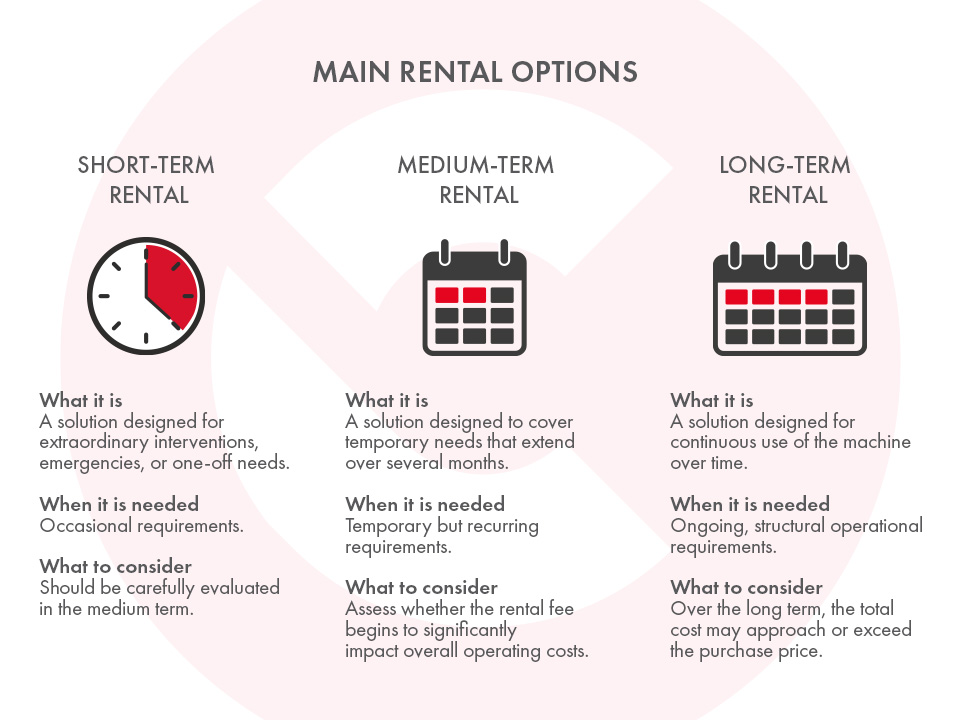
The cleaning equipment rental market offers several contractual solutions that highlight the temporary nature of the service and its primary function: addressing exceptional or transitional needs. Below is an overview of the main rental options:
- Short-term rental. Ideal for unexpected, one-off needs, such as post-construction cleaning or after an event. It responds to an emergency situation but cannot serve as the foundation for a consistent, professional cleaning program.
- Medium-term rental. Renting equipment for several months indicates a more structured requirement. In these cases, the rental fee begins to have a significant impact on the operating budget, especially when the machine is used regularly. Continuing with this option can result in higher costs precisely at the point when a direct investment would start to generate economic returns.
- Long-term rental. This option most clearly highlights the limitations of rental. When a company requires a machine on a continuous basis, long-term rental fees can lead to a total cost that, within 1–2 years, equals or exceeds the purchase price of a new machine. The key difference is that, at the end of the contract, the company owns nothing. This option should therefore be carefully evaluated, taking into account the services included in the rental, to avoid it becoming the most expensive way to have a machine available.
At first glance, rental options may appear flexible and convenient. However, a detailed analysis helps determine whether they truly represent the most cost-effective solution or whether purchasing is, instead, the more strategic choice.
Cost analysis: rental fees vs purchase depreciation
When evaluating floor cleaning equipment rental, one of the most common mistakes is focusing exclusively on the monthly fee. The lower initial cost may appear to be an immediate advantage, but a more thorough analysis shows that this model represents a recurring expense that does not generate any asset value for the company.
The rental fee is, in fact, a pure operating cost: it is paid every month to use the machine, without building ownership of any asset over time. This means that, once the contract ends, the company owns nothing and has simply incurred a continuous expense with no long-term return.
Purchasing, on the other hand, allows the equipment to be depreciated over several years, benefiting from tax advantages and progressively reducing the economic impact of the initial investment. Moreover, at the end of the depreciation period, the company still owns the machine, which continues to deliver operational value.
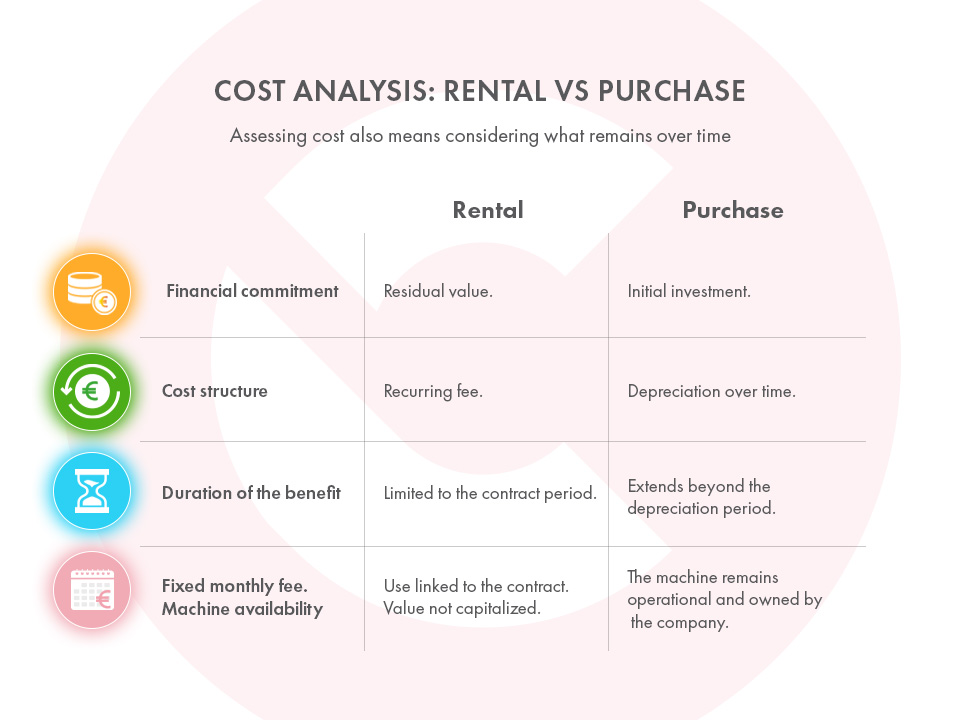
A theoretical rental example
Let’s consider a small walk-behind floor scrubber offered at €100 per month. If the contract lasts 36 months, the total cost paid by the company would be:
100€ x 36 months = 3,600€
At this point, it is important to understand what this amount actually includes. In many cases, the rental fee covers only the availability of the machine, while other essential elements further increase the overall cost:
- routine maintenance may be included, but with specific limitations;
- extraordinary maintenance is often excluded or subject to deductibles;
- brushes, squeegee blades, batteries, and other wear parts are not always included;
- professional cleaning detergents are generally paid for by the user.
As a result, the €3,600 spent on rental covers temporary use of the machine but does not guarantee full control over operating costs or consistent performance over time.
With purchasing, by contrast, the same amount can represent an investment that results in an owned asset, depreciable over time, configurable to specific needs, and usable without contractual constraints or recurring fees.
Limitations of rental and advantages of purchasing
Rental can be a useful solution in specific situations, particularly when cleaning needs are occasional or temporary. However, when requirements are continuous or demand consistently high performance, purchasing professional cleaning equipment allows for a more suitable configuration, full operational control, and greater economic sustainability over the long term. In the following sections, we examine three key factors that help guide a truly effective decision.
Tailored solution or adaptability?
Rental has its advantages, particularly when it addresses specific or temporary needs, or when it allows companies to manage extraordinary tasks without an immediate capital investment. In these situations, it can be a practical and effective solution. However, the main limitation of rental is availability. In many situations, the machine provided is simply the one available in stock, not necessarily the most suitable for the surfaces involved, the size of the areas to be cleaned, or the type of dirt the company needs to manage. This compromise can reduce cleaning effectiveness and increase working time.
Purchasing, by contrast, makes it possible to define a truly tailored configuration, selecting each component according to actual operational needs. It allows precise choices regarding:
- brush type and level of abrasiveness;
- battery capacity and required autonomy;
- dedicated accessories for specific types of dirt;
- working width and maneuverability;
- operator ergonomics and comfort.
This design flexibility results in higher performance and consistent cleaning over time, ensuring a machine that is fully integrated into daily operations rather than simply “adapted” to immediate requirements.
Immediate availability vs dependence on an external provider
Another factor that deserves careful consideration is operational continuity. An owned machine is always available and ready for use at any time: for extraordinary cleaning tasks, emergencies, night shifts, or sudden changes in work schedules.
With rental, however, the use of the equipment may depend on:
- delivery times;
- availability of the required model;
- potential downtime for maintenance managed by the provider.
For many companies, these factors may not represent an issue. For others, however, cleaning is a strategic and non-deferrable activity. In such cases, immediate availability becomes a decisive advantage that only purchasing can guarantee.
The uncertainty of maintenance and reliability
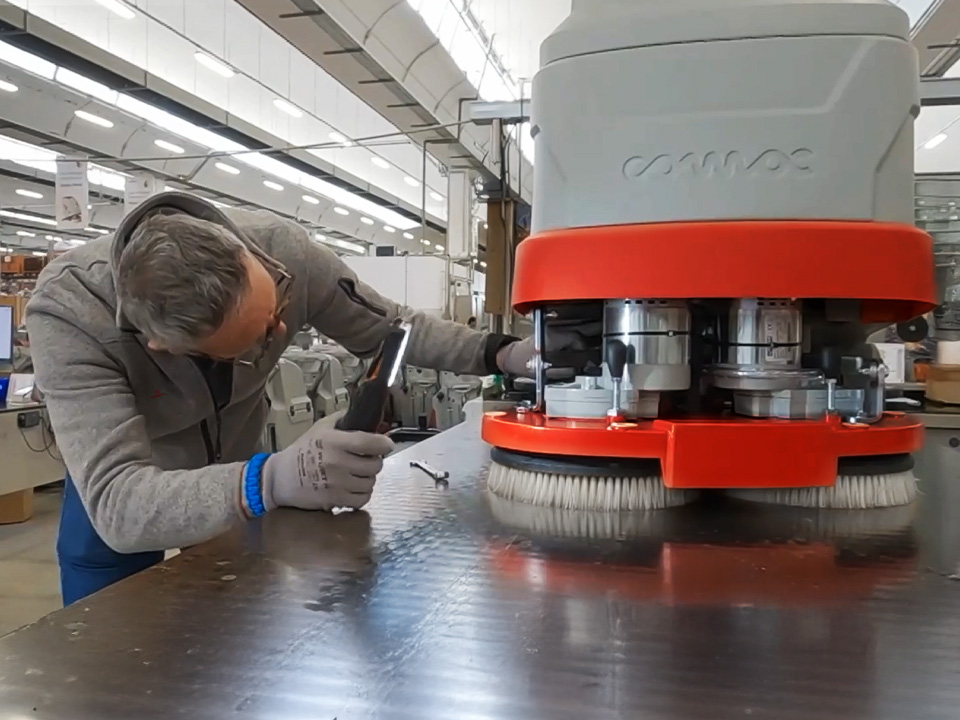
With rental, it is also important to consider the condition of the equipment. The machines provided are not always new: depending on the pricing structure, they may have already been used in previous rental agreements, with varying levels of wear and inconsistent performance. Even when regular maintenance is carried out by the provider, the company does not have full control over the machine’s history or its actual efficiency over time.
With purchasing, by contrast, the machine is managed internally from the very first use, ensuring consistent reliability and more transparent maintenance management.
When does cleaning equipment rental make sense?
There is no single answer that applies to every company. The choice between rental and purchase always depends on the operational context, the available budget, and how frequently the machine will be used. When dealing with temporary needs, seasonal peaks, extraordinary activities, or areas that must be managed only for limited periods of time, rental can be an effective and rational solution.
Rental can be particularly suitable when it is supported by a structured service that ensures rapid assistance, operational continuity, and genuine technical support. In these cases, the value lies not only in the machine itself, but in the full range of services that accompany its use, such as training, scheduled maintenance, and prompt interventions when needed.
It is therefore essential to carefully evaluate the provider offering the rental service. When rental is proposed by authorized Comac dealers, trained on the machines and organized to deliver qualified support, the value of the offering goes beyond simple equipment availability and includes technical expertise, operational continuity, and specialized know-how. In these situations, a well-defined rental solution, with transparent conditions and reliable service, can effectively meet specific operational needs.
By contrast, we recommend caution when considering excessively low-priced offers, which often conceal limitations in terms of service, coverage, or the actual condition of the equipment. In rental, as in purchasing, the quality of the partner matters just as much as the price.
How to choose the right Comac solution for your needs
Choosing the most suitable professional cleaning machine means carefully evaluating the characteristics of the areas to be cleaned, usage frequency, the type of dirt involved and the level of autonomy required. These factors are what distinguish a truly effective investment from a solution that risks becoming merely a cost.
The Comac product range includes a wide selection of floor scrubbers, sweepers, and combination machines, from compact solutions designed for small spaces to ride-on models developed to manage large surfaces and complete cleaning operations in a single pass. A precise analysis of the operational context makes it possible to identify the most efficient and sustainable model over the long term, avoiding compromises that could affect daily performance.
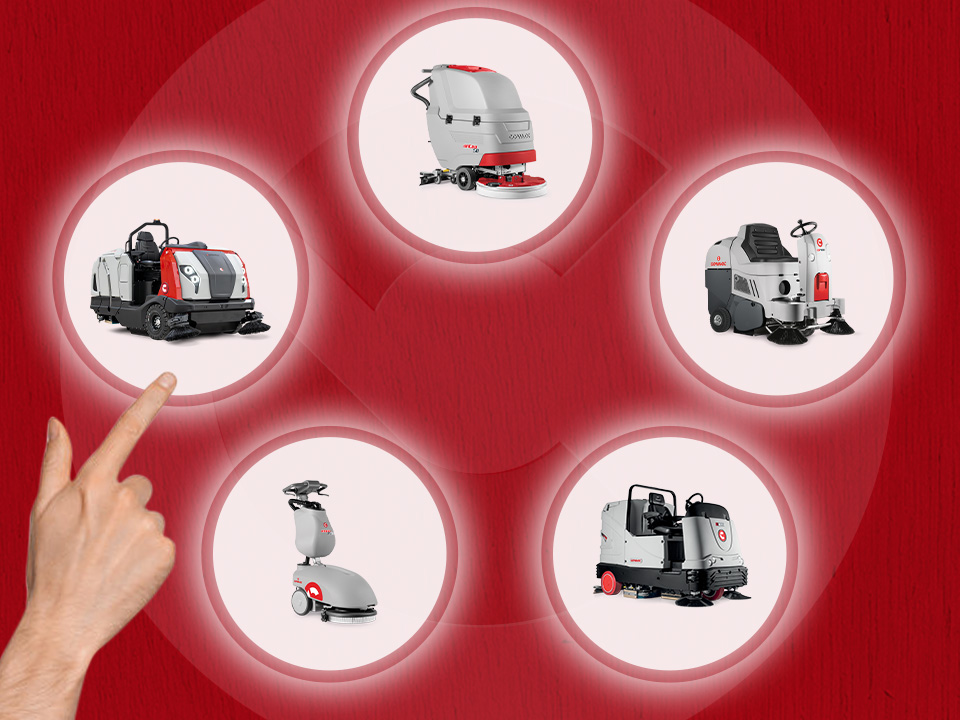
If you are unsure which machine best suits your cleaning requirements, our team is available to support you in selecting the most appropriate solution by jointly assessing technical features, operating costs, and actual cleaning needs. Contact us today for a personalized consultation.
Frequently asked questions
With rental, the machine provided is often the one available in stock. If it turns out not to be suitable for your surfaces or for the type of dirt involved, a replacement must be requested, with timing and conditions depending on the provider and the contract. This may result in operational delays or additional costs. With purchasing, by contrast, the machine is selected and configured specifically for your operating context.
Not always. Many “all-inclusive” rental contracts cover routine maintenance but exclude accidental damage, impacts, extraordinary wear, or the replacement of components such as brushes, squeegee blades, and batteries. It is therefore essential to carefully review the contract terms to avoid unexpected costs during the rental period.
It depends on the type of rental. Machines used for testing purposes may have already been operated under previous contracts and can show varying levels of wear. This may affect battery autonomy, brush performance, and suction power. Testing a new machine provides a more accurate indication of the actual performance of the selected model.
This post is also available in:


